
The diplomatic world in Paris, 17th–18th century: cultures and networks
Duration: 2026-2029
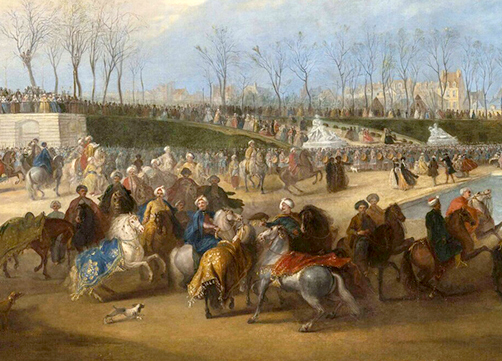
© Palace of Versailles / Christophe Fouin
This research programme seeks to contribute to the history of diplomacy in the early modern period by shifting the focus: rather than concentrating solely on treaties or on the careers of French diplomats, it takes as its subject the foreign diplomatic presence in France, observed more precisely between Paris and the court, from Versailles to Fontainebleau, via Saint-Germain, Marly, and elsewhere, while restoring the social, material and cultural depth of this milieu, from ambassadors to less visible figures such as their wives, secretaries, interpreters, agents and skilled servants. It aims to combine the use of French and foreign sources, openness to European and global contexts, and multiple collaborations, in order to conduct an enquiry that is both comparative and methodologically coherent.
Its ambition is twofold: to achieve a better understanding of the foreign diplomatic presence in the seventeenth and eighteenth centuries, and to bring together, through the establishment of a network of researchers, work that is currently scattered across several historiographical traditions and disciplines.
Context and Originality
Historiography has shed considerable light on the French state apparatus, the court, rituals, the major moments of foreign policy, and the careers of French diplomats abroad. Many studies have also focused on certain ambassadors, particular households, particular artistic commissions, certain salons, or certain forms of cultural circulation. By contrast, the foreign diplomatic world, considered as a collective object, a social milieu, and a culture in context, in which all the elements mentioned above coexist, interact, and overlap, has not yet been the subject of a comprehensive cross-cutting enquiry.
The originality of the programme therefore does not lie in the invention of an entirely new subject, but in the determination to articulate and structure existing research. The aim is to bring into relation biographies, economics, rituals, gender, spaces, sociabilities, cultural practices, and material foundations in order to understand how the foreign diplomatic presence was organised, represented, negotiated, and embedded both at court and within the courtly and urban ecosystem of Paris. Moreover, the programme fully engages with the earlier contributions of the new diplomatic history and the Global Turn, as well as with more recent historiographical approaches inspired by gender history and by the sensory materiality of social and political relations.
To explore this subject, the programme proposes to articulate four complementary structuring axes: a prosopography of foreign personnel in post and of those gravitating around them; a study of social, cultural, and ceremonial practices; an analysis of intra- and inter-court networks; and a topography of diplomatic residences and places of sociability. Each transversal axis may be examined through the non-exhaustive set of themes presented below. This articulation should make it possible to move from a fragmented history of diplomats and embassies towards a more global history of the French diplomatic world.
This reflection is intended to be multiple and interdisciplinary and takes the form of an invitation addressed to the academic world as a whole, from Master’s students to doctoral candidates, from postdoctoral researchers to established scholars, not forgetting archivists and heritage specialists, to join its activities and thereby contribute to the advancement of the field. By bringing together a plurality of expertise, this programme aims to reposition diplomatic practices within broader circulations and to gain a better understanding of the concrete, material, perceptive, and relational density of foreign presence.
General Research Question
The central question of the programme may be formulated as follows: how was the foreign diplomatic world in Paris in the seventeenth and eighteenth centuries composed, organised, and made visible?
From this general question, several sets of issues emerge. Who were the actors involved in this diplomatic presence, beyond accredited ambassadors alone? How were the formal hierarchies of diplomacy articulated with the effective hierarchies of a milieu in which rank, resources, alliances, protections, and reputations mattered just as much? Through which mediators, objects, expenditures, administrative, confessional, familial, or worldly intermediaries did these foreign representatives become embedded in Parisian and courtly hierarchies? How did foreign diplomats intervene in the public circulation of information, printed matter, and rumour in order to shape their own reputation and that of their prince beyond the strictly courtly framework? What compromises of acculturation did they make between the representation of their prince, the adoption of court norms, and the usages of the city? Finally, how were the two stages constituted by Paris and Versailles articulated? Were they complementary spaces, hierarchical spaces, or spaces in tension, and how did foreign diplomats navigate between the capital and the court, between urban sociabilities and the ceremonial requirements of royal representation? To what extent did these men and women appear as vectors of cultural transfer, of the circulation of objects, tastes, practices, and information? Finally, can one observe within this milieu a form of shared diplomatic culture, made up of common codes, sociabilities, practices, and material arrangements?
The Chronology of the Study: 1648-1792
The starting point of “1648”, that of the Peace of Westphalia and the era of Mazarinian diplomacy, appears to constitute a convenient and heuristic threshold from which certain dynamics become more legible, notably a form of consolidation of a modern diplomatic order, the gradual stabilisation of hierarchies, and the lasting establishment of diplomatic households in Paris. The end point of “1792”, for its part, corresponds to a clear political and diplomatic rupture, which profoundly transformed the frameworks of representation, the status of foreign envoys, and the conditions of their presence.
Beyond the core of the enquiry, the years “1515-1648” will provide an indispensable point of comparison so as to avoid artificially isolating the forms taken by diplomatic presence after the Peace of Westphalia. Princely receptions, the economy of magnificence inherited from the Renaissance, the first neighbourhoods of aristocratic townhouses, or the urban reconfigurations of the reign of Henry IV will not be treated for their own sake, but as elements enabling us to assess what the stabilised framework of 1648 owed to earlier prefigurations, and what it broke away from.
Finally, downstream, the period “1792-1830” will play the same role in mirror image. The international codification of precedence, the reopening of embassies, and the reconfiguration of sociabilities after the Revolutionary and Imperial interval will provide occasional observatories, rather than systematic enquiries, for assessing what in the practices and norms of Ancien Régime diplomacy endured, was transformed, or was definitively abandoned.
These two periods, before and after, will be mobilised as required by the programme’s demonstrations, during workshops or targeted study days, as comparative milestones rather than as autonomous objects of enquiry.
Themes
These themes constitute lines of enquiry intended to guide the programme without exhausting all its possible developments from the outset: they may be explored in differentiated ways depending on the enquiries undertaken, evolve over time, and be refined through the contributions of those who take part in the research network.
(Click on the themes to display their presentation.)
Diplomats and Their World
The programme will give a structuring place to a dynamic prosopography, working “from the top down”, of diplomatic personnel posted in Paris over two centuries. The programme will therefore proceed from the principle that the very term “diplomats” covers highly heterogeneous positions, statuses, and resources, which must be observed as closely as possible through concrete cases, without presupposing too rigid a hierarchy between envoys, couples, families, households, and intermediaries. It will therefore seek to identify, list, and describe ambassadors, ministers, envoys, residents, secretaries, chaplains, interpreters, agents, skilled servants, ambassadresses, family members, and staff attached to diplomatic households, including the least visible personnel, up to and including spies, who were often decisive for the concrete functioning of foreign representation. Care will also be taken to bring more clearly into view certain figures whose presence was decisive in chains of mediation, such as nuncios, informers, bankers, merchants, suppliers, and other intermediaries who, without always belonging to the visible core of the diplomatic hierarchy, contributed to the circulation of news, credit, recommendations, goods, and services indispensable to the functioning of foreign representation. The challenge is not merely to accumulate individual entries, but to reconstruct trajectories, affiliations, skills, household configurations, statuses, mobilities, confessional identities, and networks of kinship, patronage, or clientele.
Particular attention will be paid to intermediary figures and parallel networks, including illicit or concealed ones, which were often indispensable for understanding the concrete functioning of diplomacy, especially in the case of minor powers or in situations where officially accredited actors alone do not suffice to account for the circulation of information, forms of influence, and chains of mediation between different systems of norms, values, and political practices. The programme thus seeks to restore, as closely as possible to specific situations, the plurality of actors who made diplomatic action possible, and the manner in which formal hierarchies, practical competences, and informal mediations were articulated.
Diplomat writers, artists, or collectors may also form the subject of specific sub-corpora, in order better to grasp the articulation between intellectual capital, strategies of distinction, representation, cultural practices, and integration into the capital’s networks of sociability.
Women, Couples, and Agency
The programme will assign a central place to women and couples in the concrete exercise of diplomacy. Current research has clearly shown that ambassadresses and, more broadly, women gravitating around embassies and courts were by no means decorative figures, but actors in their own right, endowed with a real capacity for influence and embedded in particularly dense networks of information, sociability, and mediation. It will therefore be necessary to take into account, alongside ambassadors’ wives, female relatives, ladies-in-waiting, nurses, skilled female servants, and other female intermediaries, in order to analyse their role in the staging of representation, cultural mediation, charitable practices, correspondence, sociabilities, the circulation of news, and forms of informal diplomacy. The analysis will also consider the transnational networks within which these actors operated, whether familial, confessional, courtly, political, or amicable.
The challenge will be to consider the couple not only as a domestic unit, but also as a genuine instrument of diplomatic action. The ambassador and his wife, or more broadly the conjugal and familial configurations surrounding representation, may be studied as pairings or relational ensembles engaged in social negotiation, the maintenance of protections, the opening of access, the linking of several social worlds, and the production of reputational effects. The programme will thus seek to understand more fully how functions of visibility, intercession, recommendation, patronage, sociability, and the transmission of information were distributed between men and women, and how these practices contributed to the ordinary functioning of diplomatic presence.
This theme will also make it possible to investigate the concrete forms of female agency in the diplomatic world, taking account of the resources available, constraints of rank, confessional contexts, court usages, and the margins of initiative opened up by particular situations. It will thus be possible to analyse how certain women acted as mediators between several political and cultural spaces, facilitated material or symbolic circulations, contributed to the acculturation of diplomatic households, and helped to transform relations between the domestic sphere, political representation, and urban sociabilities. The aim is therefore not simply to add women to the diplomatic narrative, but to understand more fully how their action, that of couples, and that of female entourages fully participated in the everyday making of diplomacy.
The Splendour of Foreign Diplomacy: Ceremony, Competition, Magnificence
Paris and the court were, for foreign diplomats, stages upon which hierarchies of rank, prestige, and visibility were played out. The programme will document the economy of entries, visits, audiences, baptisms, gifts, festivities, funerals, music, processions, carriages, liveries, and other manifestations of magnificence, as political and symbolic meaning. These practices will not be treated as mere decoration, but as a political, social, and symbolic language inseparable from the strategies of representation implemented by foreign powers.
The study of conflicts of precedence, investments in representation, and moments of strong visibility will make it possible to connect ceremonial forms with the resources actually mobilised, the ambitions of powers, and the insertion of diplomatic households into courtly and urban space. Careful examination will be devoted to the economy of gifts and counter-gifts, the urban visibility of diplomatic manifestations, and the reception of these manifestations, whether in terms of court perceptions, fashionable echoes, contemporary commentaries, or the reputational effects produced by this competition in magnificence. Changes of ambassadors, transitional sequences, and moments of tension will, in this respect, provide particularly fertile observatories.
This enquiry could also usefully incorporate recent contributions from sensory history and the history of emotions. Emotions would not be envisaged as a simple subjective background to diplomatic action, but as one of its possible driving forces, in so far as they may be codified, observed, interpreted, and mobilised in situations of representation or negotiation. The management of wounded honour, the expression of gratitude, the staging of indignation, fear, or anger, as well as the political uses of restraint, affliction, or joy, could thus be studied as emotional practices in their own right. Such an approach would make it possible to understand more fully how diplomats used gestures, words, postures, affects, and sensory registers to defend a rank, seek symbolic redress, produce a persuasive effect, or obtain a political advantage. It would thus help to enrich the analysis of diplomatic rituals by restoring to them their behavioural, performative, and relational dimension.
Occupations, Sociabilities, and Acculturation
Beyond audiences and negotiations, the programme seeks to grasp ordinary social practices within the diplomatic corps. Foreign diplomats frequented salons, attended performances, went to the Opéra or the Comédie-Française, and maintained relations with the court, influential families, men of letters, artists, or financiers. They met one another, observed one another, competed with one another, and sometimes cooperated. The study of these interactions will make it possible to understand more fully the concrete forms of presence, insertion, and mutual observation within the diplomatic world and its peripheries.
The ambition is to document these social practices not as a secondary backdrop to diplomatic action, but as one of the places where it was fashioned. Cultural consumption and fashionable usages will be studied in order to assess the forms of acculturation, adaptation, or identity display that characterised the foreign diplomatic presence in Paris. The programme will also seek to determine to what extent diplomats and their entourages were not merely consumers of goods, tastes, and practices, but also, whether deliberately or not, actors in their diffusion, reuse, and hybridisation within Parisian space. Attention will also be paid to linguistic practices, reading, the circulation of news, rumour, and writings, as well as to the role of mediators and court networks in the dissemination of information, the formation of reputations, and the integration of diplomats into the various spaces of sociability in Paris and Versailles.
Intrigues and Family Life
Embassy households formed micro-societies in which couples, children, clienteles, servants, protections, and local attachments intersected. This theme will consider diplomacy as a domestic, familial, and relational reality, studying family life not as a simple private backdrop, but as a site of alliances, transfers, social strategies, negotiations of access, and the durable structuring of foreign presence in the capital. Attention will focus on the composition of households, continuities of service, kinship logics, forms of dependency, internal solidarities, and modes of local embedding that enabled diplomatic presences to endure, to be prolonged, and to be inserted into Parisian society.
This will include marriages contracted in Paris, baptisms, sponsorships, networks of spiritual kinship, relations with parishes, local alliances, as well as domestic or inheritance conflicts, tensions within households, family recompositions, widowhood, remarriage, and forms of familial sociability. The aim will be to understand how these dynamics concretely affected the functioning of embassies, shaped the circulation of persons, goods, and information, and produced effects on the stability, reputation, and effectiveness of diplomatic representation. It will also involve examining the extent to which family interests, household logics, and the demands of diplomatic service converged, adjusted to one another, or came into conflict.
The embassy will thus be approached as an expanded domestic space, in which the porosity between private and public spheres appears particularly strong. This approach will make it possible to understand more fully how diplomatic presence extended beyond official mandates, became reinscribed within broader relational, confessional, and political networks, and how the embassy household became a place for the circulation of norms, social reproduction, the transmission of information, and lasting inscription within urban and courtly hierarchies. In this sense, the study of intrigues and family life will not overlap with that of female agency strictly speaking, but will complement it by shifting the focus from individual capacities for action towards domestic structures, relational balances, and tensions framing the everyday exercise of diplomacy.
Confessional Foundations and Religious Diplomacy
Religion constituted one of the least visible but most structuring infrastructures of the foreign diplomatic presence in Paris. Embassy chapels, chaplains, sacramental practices, relations with parishes, convents, and foreign religious communities established in the capital, and confessional sociabilities more generally, formed a network parallel to the official circuits of representation, through which solidarities were forged, loyalties maintained, and protections negotiated.
The programme will seek to document these confessional foundations in all their diversity, among Catholic, Protestant, Orthodox, Muslim, or other ambassadors, by examining how the religious question was articulated with the requirements of representation at the court of the Most Christian King. Practical accommodations, tensions, strategies of confessional discretion or display, and the role of chaplains and ecclesiastical networks as mediators between diplomatic households and Parisian society will provide so many guiding threads for this enquiry.
Diplomatic Residences and the Geography of Power
A reasoned topography of diplomatic residences will constitute one of the programme’s major axes. Where did foreign diplomats live in Paris and at court? In which hôtels, in which districts, and according to what rhythms of establishment, movement, or succession? What kinds of neighbourhood relations did they maintain, and how did movements between city, court, places of worship, places of entertainment, and spaces of sociability structure their presence? The programme will seek to reconstruct the topography of diplomatic presences in its full extent, from residences and legations to confessional spaces, places of sociability, and routes linking Paris with the places of residence of the court.
The ambition is to articulate urban geography, material culture, and hierarchies of representation. Plans, views, post-mortem inventories, notarial deeds, household accounts, printed matter, and descriptive documents will make it possible to grasp more fully diplomatic interiors, libraries, paintings, vehicles, luxury objects, and, more broadly, the material foundations of foreign presence in the capital. A major place will be given to historical cartography, the analysis of urban foundations, and the forms of articulation between Paris and Versailles. Consideration will also be given to the real or claimed extraterritoriality of embassies, as well as to the symbolic boundaries that defined the embassy as a space of representation, protection, negotiation, and political visibility.
Material Aspects: Economies, Income, and Expenditure
Who financed diplomatic representation, and by what means? Sources of income, salaries, extraordinary allowances, private resources, credit, expenditure on accommodation, domestic staff, transport, clothing, performances, music, illuminations, gifts, alms, or gratuities will form the object of an analytical inventory. The programme will also take an interest in budgets, remittances, purchases and sales, the presence of diplomats within the local economic and commercial fabric, suppliers, consumption practices, and the circulation of the services necessary to the everyday and ceremonial functioning of diplomatic households.
The enquiry into budgets and the economies of magnificence should make it possible to understand more fully how diplomatic hierarchy was translated into visible practices, choices of consumption, and strategies of distinction. It will also help to measure the gap between expected norms, injunctions of representation, and the means actually mobilised. Emphasis may also be placed on inventories, gifts, luxury objects, liveries, carriages, and the circulation of objects, notably works of art and collectors’ items, in order better to grasp the materiality of representation, the forms of distinction it involved, and its inscription within the economic, social, and cultural exchanges of the capital.
Methods and Tools
The programme will rest in particular on an explicit articulation between a systematic approach and targeted enquiries.
A first component will consist in establishing a common documentary foundation: bibliography, survey of sources and of existing and ongoing research, prosopographical records, identification of residences and the principal places of sociability, and initial findings on personnel, households, and practices. This work is intended to produce tools useful to the entire network of researchers.
A second component will consist in identifying and launching case-study files designed to test hypotheses, refine analytical categories, and make the programme immediately productive. These case-study files may focus, for example, on moments of change of ambassador, on particular powers or principalities, on parallel networks of agents, on ambassadors’ wives, on corpora of audiences, on the salons frequented by diplomats, or on material and artistic circulations. Relying primarily on first-hand sources, these case-study files will aim above all to connect, wherever possible, a fonds or documentary collection with a precise case study, in order to highlight not only the contributions of the material, but also its granularity, its biases of production, its weak points, its possibilities for cross-referencing with other series, and, where relevant, its comparative potential across different political spaces.
The priority corpora and fonds to be mobilised are to be found, on the one hand, in French archives, first and foremost among them the archives of the Ministry of Foreign Affairs, in La Courneuve as well as in Nantes, the fonds of the Paris lieutenant général de police, the resources of the Bibliothèque nationale de France, notarial archives, parish registers, plans, and views of Paris. They are to be found, on the other hand, in foreign fonds, namely the chancery archives and diplomatic repositories of the countries of origin, whose contribution is indispensable for reconstructing what French sources reveal only partially: instructions received, reports of audiences, private correspondence, household accounts, and financial documents preserved in Vienna, Madrid, London, Rome, or Lisbon. The identification, description, and assessment of these foreign fonds will fully form part of the enquiry conducted by members of the research network, in so far as these fonds are often dispersed, unevenly accessible, and structured in highly diverse ways according to the administrative traditions that produced them. The programme thus intends to make the identification of these corpora, their classificatory logics, and their conditions of use an object of reflection in its own right, indispensable to any comparative history of diplomatic presence in Paris. Both documentary ensembles will moreover be the subject of dedicated research workshops.
The principal tools mobilised will be the following: prosopography and interoperable databases; network analysis; historical cartography supported by geographical information systems (GIS); economic series; the study of rites and the scenographies of magnificence; and the cross-use of correspondence, administrative archives, notarial archives, police records, printed matter, periodicals, visual documents, and private sources. From the programme’s conception onwards, emphasis will be placed on the digital dimension of the enquiry: databases and cartographic tools will be constructed according to interoperability standards enabling their articulation with the PROSOCOUR database and, in due course, with other European projects dealing with comparable corpora. Reflection on source encoding and descriptive formats will ensure that the tools produced remain reusable and capable of enrichment beyond the programme’s duration. The raw textual data will be deposited on data.gouv.fr.
Productions planned
The programme aims both to advance research on the foreign diplomatic presence between Paris and the court, and to produce common tools capable of structuring the field on a lasting basis:
• a bibliography and a list of sources;
• a directory of researchers and research projects;
• an initial prosopographical core of the Parisian diplomatic world, capable of being articulated with the CRCV’s digital environment (PROSOCOUR database);
• a map of diplomatic residences and of the principal places frequented in Paris;
• thematic research workshops on sources, enabling research to be brought together and hypotheses to be tested through case studies;
• a reasoned survey of the principal foreign fonds available for the study of the diplomatic world in Paris, specifying their nature, accessibility, heuristic interest, and possibilities for cross-referencing with French sources;
• a study day devoted to a specific case-study file;
• a final conference intended for the presentation of syntheses;
• publication of the proceedings of the workshops and the study day;
• a collective volume of synthesis;
• documentary corpora targeted at certain rites, practices, groups of actors, or material configurations.
Team
The programme is conceived as an open research network of scholars, structured around a scientific direction and a set of members, correspondents, or contributors mobilised according to themes, documentary areas, and skills. This architecture is intended both to ensure overall coherence, to recognise the contribution of each participant, and to build over time a common working space devoted to the social, material, and cultural history of foreign diplomacy in France.
Director of the research programme: Lucien Bély, Emeritus Professor (Sorbonne Université), Chair of the Scientific Committee (CRCV).
Internal working team: Mathilde Deroin, Research Officer (CRCV); Benjamin Ringot, Head of Research, Events, and Training (CRCV).
Members of the research network (currently being constituted)
Current Call for Papers
Call for papers for a virtual research workshop: “The Diplomatic World in Paris, Seventeenth and Eighteenth Centuries: Cultures and Networks. Sources held outside France”, online, 16 December 2026; submission deadline: 31 May 2026.